
Cineuropa: Our People is based on a real event which shook Slovakian society in 2018. When and how did you get the idea to make a series about this?
Miro Šifra: The initial idea came from a Czech producer. We were still in the thick of the situation and we didn’t really grasp how important it might be for other countries, and that this story deserved to be told from a wider perspective. A producer approached about trying to make a series about it. At that point in time, our angle was hope, because a presidential election had just taken place and the new president was an anti-corruption leader. The idea was to end the series with her accession to power in a country which had been through hell but had rediscovered hope. But, four years later, the previous government was back in power, and it was even worse than before, so the tone of the story took a wholly different direction. But now it’s even more vital that we speak about what happened.
For those who aren’t familiar with the story, what is Our People about?
Tereza Nvotová: It’s the story of a journalist (Ed., Ján Kuciak) who was murdered, and not all that long ago, in 2018. Sadly, he isn’t the only journalist around the world to have been killed in recent times: there’s some kind of planetary epidemic underway. We came to realise that the truth really is under threat. The story begins with the murder, but it’s not about an officer trying to find out who did it and arresting the culprits, because he realises that this murder actually masks a far bigger crime committed by the system which was running the entire country, a government under mafia control. And this system even has a name: Our People. That’s why we chose this title for the series. And it’s also why, given that this system is back in power, we couldn’t find a broadcaster in Slovakia.
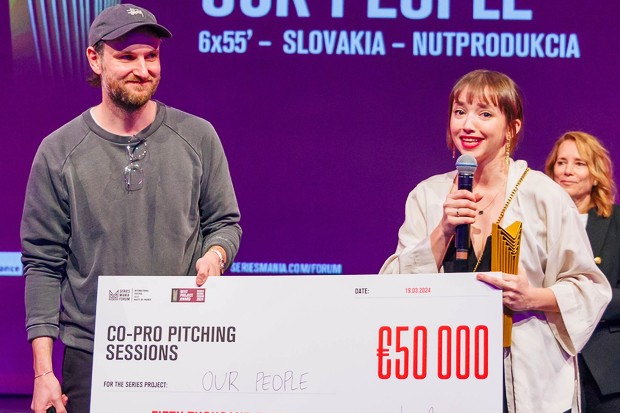
Produced by Jakub Viktorín and Tomáš Hrubý on behalf of Slovakian firm nutprodukcia, Our People will be directed by Tereza Nvotová (discovered in Rotterdam’s Bright Future line-up in 2017 thanks to Filthy [+] and awarded the Golden Leopard in Locarno’s 2022 Cineasti del Presente section via Nightsiren [+]) who also wrote the series’ screenplay with Miro Šifra (who authored We Have Never Been Modern [+] and the mini-series Rats, among other works). Cineuropa chatted with them in Lille, the day after their victory in the Series Mania Forum’s Co-Pro Pitching Sessions.
How faithful were you to real-life events during the writing phase?
TN: We lived through these events, they weren’t just details we picked up along the way. There were huge demonstrations, even bigger than the ones in the Velvet Revolution (1989). Every day brought a new flurry of revelations on connections with oligarchs, MPs, etc. We lived through these events for a number of years, like many Slovaks. But it’s actually impossible to fully understand such a continual and overwhelming stream of information at the time. You see the individual elements (some of which are becoming invisible again, being swept under the carpet) but not the overall picture, which makes it easier for the “guilty parties” to return to power. So it was even more essential that we tell this story. We tried to get as close to the truth as possible, by carrying out in-depth research, notably using the thousands of pages of police files and by keeping close contact with Ján and Martina’s parents (Ed., Martina was the journalist’s partner who was killed alongside him). But as truthful as the series is, it’s ultimately fiction, because the audience needs a clear story that it can connect with emotionally. I think this is the way that we can change ourselves and then change things around us.
Who are the main characters?
MS: The story is told from various perspectives, but the main character is the investigating officer. And we don’t only see the victims’ side, we also follow the murderers and those giving the orders, in order to provide the fuller picture.
What stage are you at with the project?
TN: We have a treatment and a pilot episode ready to go. We hope to commence filming next year if we can pull the funding together. Obviously, being selected in Series Mania, and this award, are a huge help. We need to make the most of this momentum to get closer to broadcasters all over Europe, because the general feeling is that this isn’t a local story because it could happen anywhere. We all thought that the mafia had become white collar oligarchs who didn’t need to kill, because they could destroy us financially or in some other way. But it happened, and we said to ourselves: we’re not where we thought we were, in a safe western country. And unfortunately, it’s a phenomenon which is spreading throughout the western world.
How important do you think your participation in CPH:DOX was, overall?
CPH:LAB proved to be helpful beyond our expectations. Sharing knowledge is a key element in such an innovative and novel medium. We’ve learned so much from our mentors and fellow participants. Participating in the festival allowed us to test our ideas and prototype on a wide range of industry players. The data we collected over the three days of pitching, presentations and symposiums will be highly valuable in taking Garden Alchemy to the next stage.
What can you tell us about the visual concept and the research work you’re conducting for the project?
We’re conducting our research as part of the R&D department of The Animation Workshop/VIA University College. We’re working with traditional painting and printmaking, and are incorporating the craft of hand-made animation into our digital experiments with game engines and machine learning. Plus, we’re working closely with experts in performing arts and technology, and researchers in education for sustainable development.
What kinds of partners are you looking for?
We are still on the lookout for production funding along with finding partners who can help us distribute this [type of] work – namely, location-based, multi-user installations.
What’s next for you?
We will head towards the second stage of development and the beginning of production, starting on a small scale by testing it on four users before moving on to the optimal full scale of ten players. We need to explore reactivity and interactivity between users, and the incorporation of sound and music as a story element in the piece.